
How I Prepare a Vintage Watch Before It Goes in the Shop
Every vintage watch starts with a little mystery.
Sometimes it is running. Sometimes it is dead. Sometimes it looks clean in a photo, but once you get it under a light, you realize it has decades of dirt in the bracelet, around the case back, under the lugs, and inside every tiny little corner.
That is normal.
Old watches are dirty.
Before I can fairly represent a watch in the Toto’s shop, I need to get a much better look at what is actually there. That usually starts with the most basic thing in the world: cleaning.
Cleaning comes first.
A soft toothbrush, cold water, a little dish soap, and patience can do a lot. You would be surprised how many old watches improve dramatically once you remove the grime. Bracelet links loosen up. Case edges become visible again. A dial that looked dull may suddenly have more life because the crystal and case are no longer covered in film.
Of course, not every watch can be cleaned the same way. You have to be careful around old cases, plated finishes, non-waterproof watches, and anything with a questionable seal. Vintage watches are not pressure tested unless specifically noted, and I do not treat them like modern waterproof watches.
Sometimes basic cleaning is enough.
Sometimes it is not.
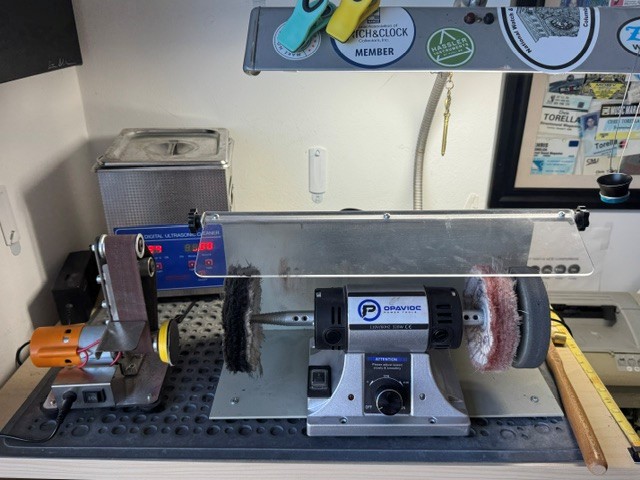
For some bracelets and cases, I may use an ultrasonic cleaner. For others, I may use a metal polish, polishing cloth, or more careful hand work. If a crystal is acrylic and badly scratched, I may polish it. If a case has rough marks or a bracelet is dull and tired, I may gently improve the finish.
Polishing is not always the enemy.
This is where people sometimes say, “Never polish a vintage watch.”
I understand where that comes from. If you are talking about a collectible Rolex, Omega, or high-end vintage piece, aggressive polishing can absolutely hurt value. Original case lines matter. Sharp edges matter. Collectors care about that.
But that is not every watch.
A lot of the watches I work with are affordable vintage ladies watches, fashion watches, character watches, bracelet watches, pendant watches, and everyday pieces that were made to be worn. On those watches, there is a real difference between attractive age and plain old dirt, damage, or neglect.
There is also a difference between patina and wear that makes a piece less enjoyable.
I am not trying to make an old watch look brand new. I am trying to make it wearable, presentable, and honestly described. Sometimes that means leaving age alone. Sometimes it means cleaning. Sometimes it means polishing a crystal so the dial can be seen again. Sometimes it means taking a tired bracelet and giving it back some shine.
Then I check the function.
After the cleaning, I check the function.
For a mechanical watch, I use a timegrapher when appropriate. It gives me a better sense of how the movement is running, whether the beat is healthy, and whether the watch is behaving in a way that makes sense for its age and condition.
For a quartz watch, the first question is often whether the movement has life. A fresh battery may be enough, but not always. I also use a battery pulse checker, which helps confirm whether the quartz movement is sending a signal and trying to run. That can tell me the difference between a watch that may need a battery, a watch with a stuck gear train, and a watch with a more serious movement issue.
Those checks matter because “not running” does not always mean the same thing.
Some watches need a battery. Some need cleaning. Some need service. Some are parts watches. Some are not worth going further with. The point is to know as much as I reasonably can before describing the piece.
The practical details matter.
Then I look at the practical details.
Does the crown work? Do the hands set? Does the clasp hold? Is the bracelet stretched? What wrist size will it fit? Are there cracks in the crystal? Is there plating wear? Is the dial clean, aged, spotted, or damaged? Does the watch feel wearable, or is it more of a project?
Those details are what turn a pretty picture into a useful listing.
Not every vintage watch in the shop is perfect. Most are not. They are old objects, and old objects have stories. My job is not to pretend otherwise.
My job is to clean them up, check what I can, describe what I see, and help the right person decide whether the watch belongs with them.
A good vintage watch does not have to be flawless.
It just has to be honest, wearable when possible, and still full of life.
Browse vintage watches from Toto’s
See the latest vintage watches and jewelry from Toto’s, with condition notes and purchases handled securely through Etsy.
Shop Toto’s on Etsy →